Teori — Narrative Text: The Story of a Friendly Future
1. What Is a Narrative Text?
A narrative text tells a connected series of events involving characters, a setting, and a problem. Its main communicative purpose is usually to entertain or engage readers. At the same time, a narrative may invite readers to reflect on values, choices, social issues, or human experiences.
A narrative is different from a report or an explanation.
| Text type |
Main focus |
| Narrative |
Characters face events and a problem that develops into a plot |
| Report |
General factual information about a class of things |
| Explanation |
How or why a process happens |
| Procedure |
Steps for doing or making something |
A narrative about renewable energy does not need to explain every technical detail. The energy issue functions as the context in which the characters make decisions and face consequences.
2. Communicative Purpose
Depending on the story, a narrative may:
- entertain readers;
- build suspense or curiosity;
- explore a problem through characters and events;
- show the consequences of a decision;
- communicate a value without directly lecturing readers;
- help readers imagine a different future.
When identifying the purpose, avoid answers that are too broad, such as “to give information.” Ask instead:
What experience does the story create, and what does it invite the reader to consider?
3. Schematic Structure
Narratives commonly use the following stages.
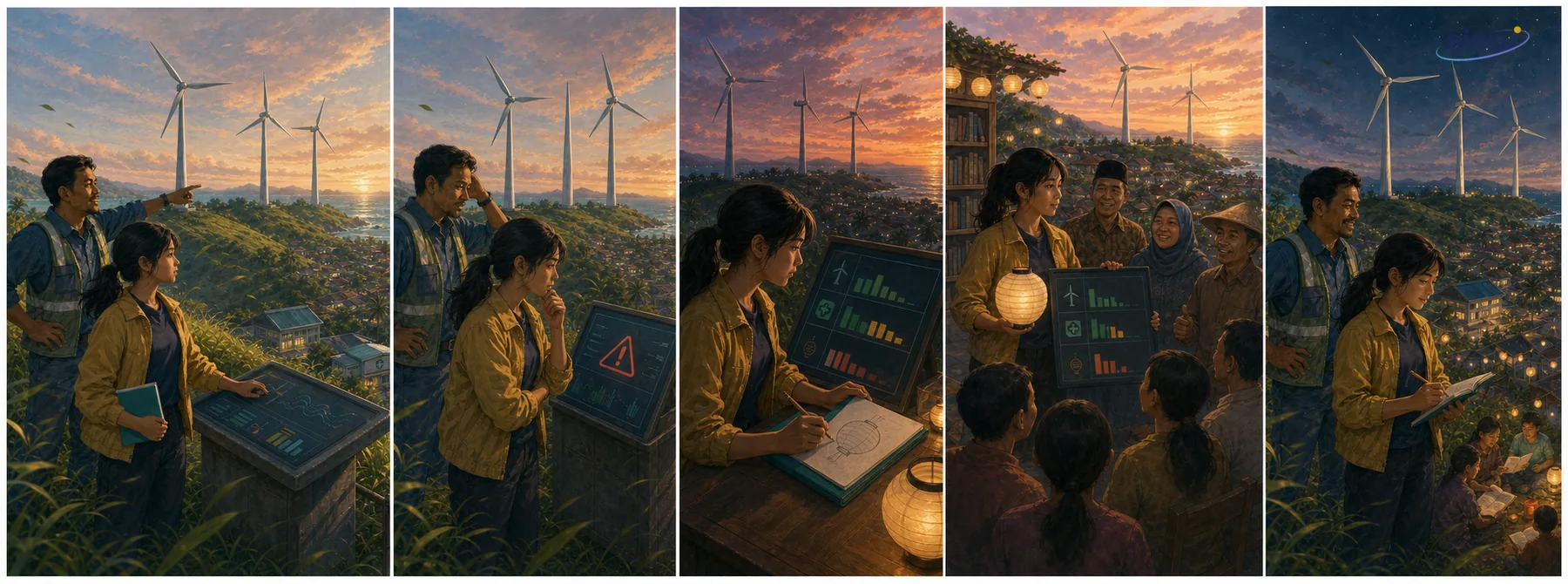
Read the panels from left to right: orientation, complication, evaluation, resolution, and coda. Notice how each stage changes the situation rather than merely adding another event.
3.1 Orientation
The orientation introduces:
- the main characters;
- the setting of time and place;
- the initial situation.
Example:
Mira lived in a coastal village where the evening market depended on an old diesel generator.
3.2 Complication
The complication presents a problem or unexpected event. A story may have one major complication or several connected difficulties.
Example:
One stormy evening, the generator stopped, and the market lost its only source of light.
3.3 Evaluation
The evaluation builds tension. It shows the characters considering the problem, feeling uncertain, or facing a difficult choice. Not every narrative marks this stage separately, but it often makes the plot more engaging.
Example:
Mira had one night to decide whether to use the school’s unfinished solar lamps or wait for a repair team that might arrive too late.
3.4 Resolution
The resolution shows how the main problem is solved, partly solved, or accepted. A believable resolution should grow from earlier events and character choices.
Example:
With help from her classmates, Mira tested the lamps and placed them along the market path before sunset.
3.5 Coda
A coda is an optional closing comment. It may state a lesson, show a later change, or invite reflection.
Example:
From that night on, the villagers treated energy planning as a shared responsibility.
4. Plot Development
A plot is not simply a list of events. The events need a meaningful connection.
Weak sequence:
Dani woke up. He ate breakfast. He saw a turbine. He went home.
Stronger plot:
Dani discovered that the school turbine had stopped before an important evening event. He searched for the cause, made a risky assumption, corrected his mistake, and restored the system with help from the maintenance team.
The stronger version has:
- a clear goal;
- a complication;
- cause-and-effect relationships;
- a change in the character’s understanding;
- a resolution connected to the problem.
5. Language Features
5.1 Simple Past Tense
Narratives often describe completed events in the past.
Verbal sentences
Affirmative:
Sinta checked the battery.
Negative:
Sinta did not ignore the warning.
Interrogative:
Did Sinta check the battery?
After did or did not, use the base form:
- correct:
did not check
- incorrect:
did not checked
Nominal sentences
Use was or were when the predicate is not an action verb.
The control room was quiet.
The villagers were worried.
5.2 Action Verbs
Action verbs show what characters do.
Examples:
- carried;
- repaired;
- climbed;
- connected;
- examined;
- whispered;
- gathered;
- switched.
Specific verbs make a story clearer. Compare:
- general:
Raka did something to the cable.
- specific:
Raka examined the cable and tightened the loose connector.
5.3 Saying Verbs
Saying verbs introduce or describe speech.
Examples:
- said;
- asked;
- replied;
- warned;
- explained;
- suggested;
- admitted;
- promised.
Choose a verb that fits the speaker’s intention.
“The clouds are moving closer,” Lila warned.
“We can store the remaining power,” Bimo suggested.
5.4 Direct Speech
Direct speech presents a speaker’s exact words.
“We still have enough power for the clinic,” Arman said.
Useful punctuation principles:
- place quotation marks around the spoken words;
- use a comma before the reporting clause when appropriate;
- begin the quotation with a capital letter;
- place the final punctuation inside the closing quotation mark.
Indirect reporting gives the meaning without quoting the exact words.
Arman said that they still had enough power for the clinic.
5.5 Time Conjunctions and Sequencing Expressions
These expressions help readers follow the order of events:
- at first;
- one morning;
- when;
- while;
- after;
- before;
- as soon as;
- later;
- suddenly;
- eventually;
- in the end.
Do not begin every sentence with then. Vary the connectors and show relationships between events.
5.6 Pronoun References
Pronouns prevent unnecessary repetition, but their references must be clear.
Unclear:
Tia told Nara that she had repaired the lamp.
Who repaired the lamp—Tia or Nara?
Clear:
Tia said, “Nara, I have repaired the lamp.”
or:
After Nara repaired the lamp, Tia thanked her.
5.7 Descriptive Details
Selected sensory details help readers imagine the setting.
The blades turned slowly above the dry grass, and a soft mechanical hum crossed the hill.
Use details that support the mood or plot. Too many unrelated adjectives can slow the story.
6. Reading a Narrative Critically
6.1 Finding the Main Idea
The main idea is the central point of a paragraph or section. It is not always the first sentence.
Ask:
- Who or what is mainly discussed?
- What important change or problem occurs?
- Which details support the central point?
6.2 Locating Explicit Information
Explicit information is directly stated.
Text:
The battery indicator showed only twelve percent.
Question:
How much energy remained?
Answer:
Twelve percent.
6.3 Making an Inference
Implicit information is not stated directly. Readers combine textual evidence with logical reasoning.
Text:
Damar checked the dark clouds, lowered the flag, and asked everyone to leave the open field.
Reasonable inference:
Damar expected dangerous weather.
An inference needs evidence. It should not be a random guess.
6.4 Identifying Reference
Text:
The students presented a new storage plan to the council. It included a schedule for charging essential devices.
It refers to the new storage plan.
6.5 Understanding Vocabulary in Context
Do not translate a word without considering the sentence.
The villagers reserved the stored power for the clinic.
Here, reserved means “kept for a particular purpose,” not “booked a seat.”
7. Original Model Text
The following story was written specifically for this chapter.
The Wind Keeper of Tanjung Aruna
Nara lived in Tanjung Aruna, a small coastal town where strong winds arrived every afternoon. On the hill above the town stood three community wind turbines. Nara’s mother called them “the silver guardians” because they powered the library, the health post, and the lamps along the harbor road. Nara often visited the hill with Pak Dimas, the technician who cared for the turbines.
One week before the town’s night reading festival, the second turbine began to stop without warning. Pak Dimas inspected the tower and found that its monitoring sensor was sending incorrect temperature data. A replacement sensor had been ordered, but rough seas delayed the supply boat. If another turbine failed, the town would not have enough stored electricity for both the festival and essential services.
The festival committee wanted to continue as planned. “The children have prepared for months,” one member argued. The health workers, however, asked the town to protect the clinic’s electricity supply. Nara listened quietly. She loved the festival, but she also remembered the emergency lights in the clinic.
That evening, Nara studied the town’s energy board. She noticed that decorative lamps used almost as much electricity as the library reading area. She drew a new plan: the festival could begin before sunset, use only the central reading lamps, and replace the electric decorations with reflective paper made by the art club. The stored energy for the clinic would remain untouched.
The next morning, Nara presented her plan. Some committee members doubted that a simpler festival would feel special. Nara did not argue immediately. Instead, she showed them the energy estimates and a small reflective lantern. When sunlight struck the folded paper, bright patterns moved across the wall.
Pak Dimas smiled. “A good solution does not hide the limitation,” he said. “It works responsibly within it.”
The committee accepted the plan. On festival night, families arrived while the sky was still orange. Students read stories under efficient lamps, and hundreds of paper shapes reflected the remaining daylight. The wind grew stronger after dusk, but the town did not increase its electricity use. The clinic kept its full energy reserve.
Two days later, the supply boat brought the new sensor. Nara helped Pak Dimas record the repair. She had not fixed the turbine herself, yet she had helped the town face the problem without sacrificing safety. From then on, the people of Tanjung Aruna called her the wind keeper—not because she controlled the wind, but because she reminded them to use its power wisely.
8. Analyzing the Model Text
| Stage |
Evidence from the plot |
Function |
| Orientation |
Nara, Tanjung Aruna, Pak Dimas, and the turbines are introduced |
Establishes characters, setting, and initial situation |
| Complication |
A turbine sensor fails before the festival |
Creates a conflict between celebration and essential energy needs |
| Evaluation |
The committee and health workers have different priorities; Nara studies the energy board |
Builds tension and shows the difficult choice |
| Resolution |
Nara proposes a lower-energy festival and supports it with evidence |
Solves the problem without risking the clinic |
| Coda |
Nara becomes known as the wind keeper |
Shows the lasting meaning of her action |
Character Development
At the beginning, Nara is an interested observer. During the conflict, she analyzes evidence and communicates a compromise. By the end, she becomes a responsible problem-solver. This change makes the resolution feel connected to her actions.
Theme
The story suggests that innovation is not always a new machine. It may also be a responsible decision about how limited resources are used.
Language Evidence
- Past tense:
lived, stood, began, noticed, accepted.
- Action verbs:
inspected, studied, drew, presented, recorded.
- Saying verbs:
argued, asked, said.
- Time expressions:
one week before, that evening, the next morning, on festival night, two days later.
- Direct speech: Pak Dimas’s statement about a responsible solution.
9. Listening Without a Recorded Audio File
For now, listening practice can use an original teacher-read script. Students should close the text while listening.
Read-Aloud Script
On Monday afternoon, Salma heard that the school greenhouse had lost power. The automatic watering timer had stopped, and the seedlings could not wait until the next day. Salma first suggested using the emergency battery, but the science teacher explained that it was reserved for laboratory safety equipment. After checking the weather, Salma and her friends carried water by hand. They also moved a small solar panel to a brighter place so the timer could restart before sunset. The work took longer than pressing a switch, but every seedling survived.
Suggested listening tasks:
- Identify the setting and main problem.
- Note Salma’s first suggestion.
- Explain why the emergency battery was not used.
- Sequence the actions taken by the students.
- Infer one character trait shown by Salma.
The script is original and does not depend on copied audio.
10. Speaking and Retelling
A good retelling:
- keeps the important characters and events;
- follows a logical order;
- uses past tense consistently;
- does not repeat every sentence;
- includes the problem and resolution;
- may state the message in the speaker’s own words.
Useful retelling frame:
The story took place in .... The main character was .... At first, .... The problem began when .... Because of this, .... Eventually, .... From the story, I learned that ....
For a dialogue task, students may discuss a character’s decision:
A: Do you think Nara made the right decision?
B: Yes. She protected the clinic’s energy supply while keeping the festival possible.
A: What made her proposal convincing?
B: She supported it with energy estimates and a working example.
11. Viewing Through a Written Storyboard
Study the visual storyboard before reading its description. Use details such as the moving or still turbines, warning symbol, energy bars, lantern sketch, clinic indicator, and reading activity as evidence for your interpretation.
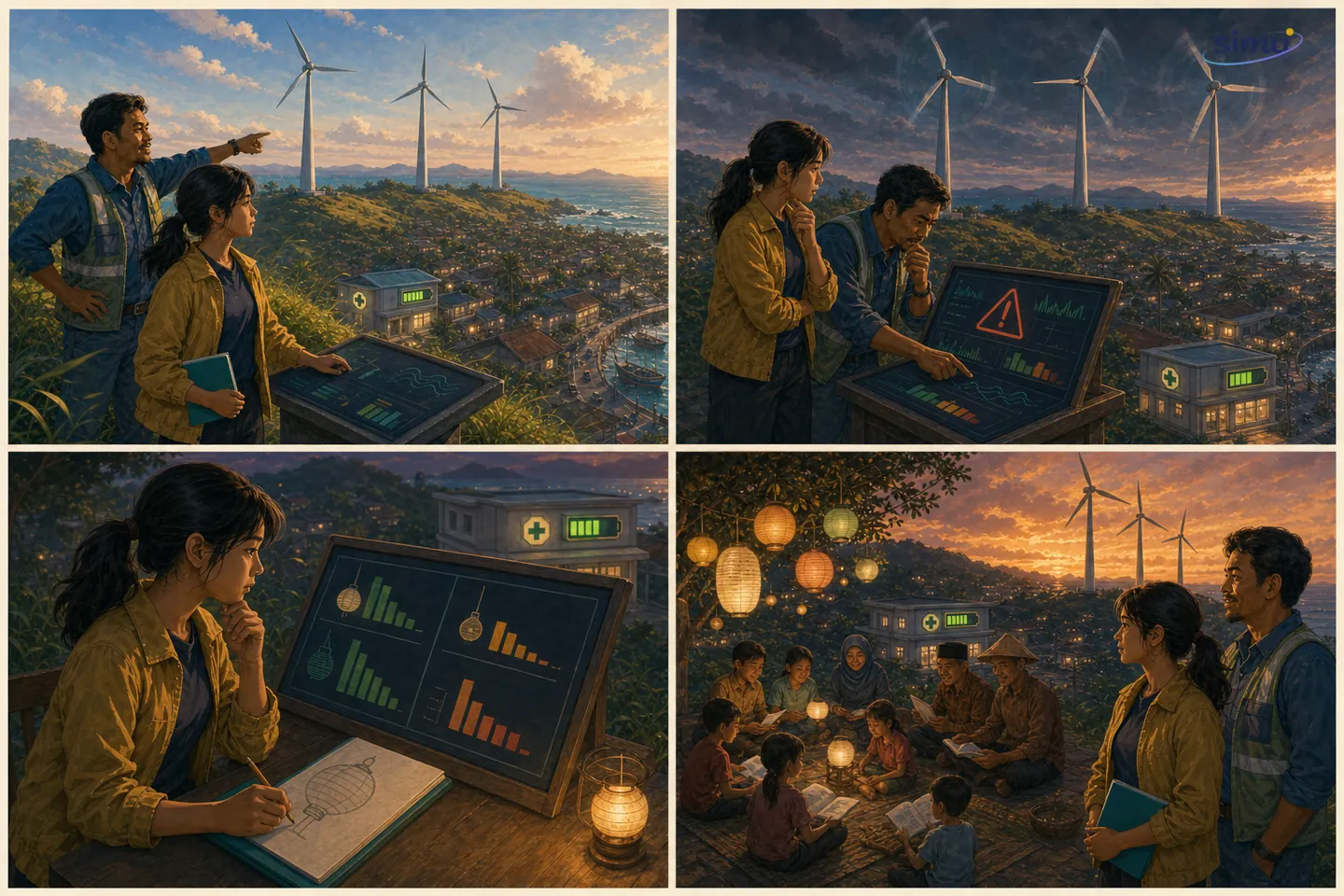
| Panel |
Visual description |
Narrative function |
| 1 |
Three turbines above a coastal town; Nara and Pak Dimas stand near an energy board |
Orientation |
| 2 |
One turbine is still; a warning symbol appears on the monitoring screen |
Complication |
| 3 |
Nara compares two energy-use bars and sketches a paper lantern |
Evaluation |
| 4 |
Children read under central lamps while reflective decorations glow; the clinic indicator remains full |
Resolution |
Viewing questions:
- Which details identify the setting?
- How does panel 2 signal a problem?
- What information in panel 3 shows Nara’s reasoning?
- How does panel 4 communicate the resolution without a long caption?
12. Writing an Original Narrative
Step 1: Define the purpose and audience
Decide:
- Who will read the story?
- Should the story mainly entertain, inspire, or invite reflection?
- What environmental issue will provide the context?
Step 2: Complete a story map
| Element |
Planning question |
| Character |
Who wants or needs something? |
| Setting |
Where and when does the story happen? |
| Initial situation |
What is normal at the beginning? |
| Complication |
What disrupts the situation? |
| Stakes |
Why does the problem matter? |
| Attempts |
What does the character try? |
| Resolution |
How is the main problem addressed? |
| Coda |
What changes or what is learned? |
Step 3: Draft
Write the first version without trying to make every sentence perfect. Focus on:
- a coherent plot;
- meaningful paragraphing;
- clear references;
- consistent past tense;
- relevant details.
Step 4: Peer review
Ask a classmate to check:
- Is the complication clear?
- Does the tension grow?
- Does the resolution follow logically?
- Are pronoun references clear?
- Are past-tense forms correct?
- Which detail is most memorable?
- Which sentence needs clarification?
Step 5: Redraft
Revision is more than correcting spelling. A writer may:
- reorder events;
- add necessary evidence;
- remove irrelevant details;
- clarify the character’s motivation;
- strengthen the resolution;
- correct grammar and punctuation.
13. Presentation Checklist
When presenting a narrative:
- introduce the title and context;
- speak at an understandable pace;
- vary intonation during important events;
- pronounce key vocabulary clearly;
- maintain eye contact when possible;
- use brief notes rather than reading every line;
- answer audience questions politely.
14. Common Problems
Problem 1: The text is descriptive but has no plot
Fix: add a character goal, a complication, and a consequence.
Problem 2: The resolution appears suddenly
Fix: plant clues, skills, or resources earlier in the story.
Problem 3: Every sentence begins with “Then”
Fix: vary time conjunctions and combine closely related events.
Problem 4: Past tense is inconsistent
Fix: underline the verbs and check whether each event is completed in the past.
Problem 5: The environmental message becomes a lecture
Fix: let the message emerge from characters’ choices and consequences.
Problem 6: Renewable energy is presented as a perfect solution
Fix: show realistic limitations such as weather, maintenance, storage, cost, or competing needs without turning the story into a technical report.
15. Summary
A successful narrative:
- engages readers through characters and a connected plot;
- establishes an orientation;
- develops a meaningful complication and tension;
- provides a believable resolution;
- uses suitable past-tense and narrative language;
- supports interpretation with explicit and implicit information;
- reflects a purpose and audience;
- improves through planning, feedback, and revision.